
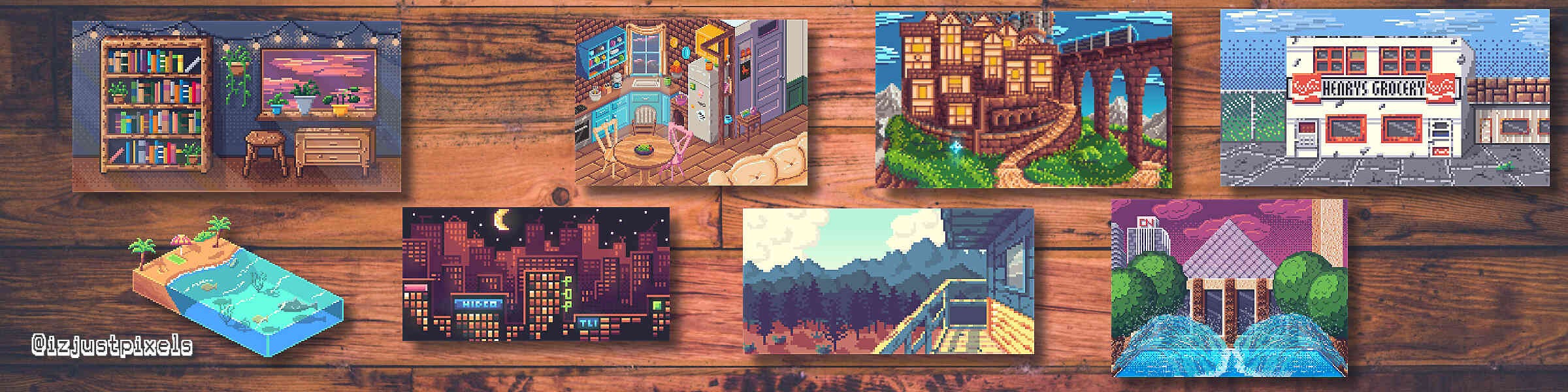
Pixel art is a digital art style characterized by low-resolution, blocky scenes reminiscent of impressionistic paintings. Digital artists originally created pixel art for video games in the ‘80s and ‘90s. The hardware limitations of console games at that time meant that video game files had to be small. Even though the same technical limitations no longer exist today, the style is nostalgic for many and has remained immensely popular.
As with many other artistic styles, pixel artists can generate income through a variety of sources: from private commissions and creating products from their art, to designing sprites and scenes for video games and creating art for online publications.
Last week, I met with Izzy Hubert Lyall to chat about art and business. Izzy creates dreamy pixelscapes through her online business izjustpixels, based in Edmonton, Alberta (Canada).
A lifelong gamer, Izzy has always enjoyed the vibe of retro games but didn’t (and still doesn’t) consider herself a very artistic person. Art class wasn’t very encouraging growing up and picking up a paintbrush was never her jam. After following pixel art social media accounts for years, she began making her own art in 2021, creating scenes from her imagination and from her life in Edmonton. She found pixel art to be very accessible in the beginning because of the welcoming community and the availability of online tutorials.
When she is working on her art, Izzy finds that she becomes so absorbed that she enters a flow state, where time and worry seem to melt away. She creates best in a quiet, cozy atmosphere: listening to lo-fi music with a mug of hot tea or coffee in the wintertime works best.
Izzy’s creative inspiration comes from a variety of places. She loves spending time on something enjoyable that sparks interest and appreciation in others. Her projects often use Edmonton landmarks as their subject, making them instantly recognizable to those in her local community. Izzy also enjoys following the development of other pixel artists online. Some have started only a few years ago and have gone on to design art for online publications and video games.
Creating pixel art requires the use of a few standard digital tools:
In addition to these tools, Izzy supports her business using the following technologies:
Custom domain (NameCheap)
Website code (GitHub Pages)
Print-on-demand products (Redbubble)
Commission payment processing & digital art storefront (Ko-fi)
Social media community (Mastodon, Pixelfed, DeviantArt)
Izzy chooses to be completely AI-free in art and in the business tools she uses. There are practical reasons for this: generative AI models haven’t yet mastered the unique constraints of this style of art. It isn’t yet possible for AI models to generate pixel art images that make sense. Izzy has ethical concerns as well. The AI models that exist today are trained on digital and digitized art without artists’ permission and without compensation or recognition. This makes using contemporary models to generate and sell art ethically questionable in her eyes. Finally, Izzy thinks the act of creating art is enjoyable! She draws on an analogy to weightlifting: we can design a robot to move heavy objects from point A to B, of course, but the goal of weightlifting is the change experienced by the process. She feels making art works the same way—the goal is the process, not necessarily the product.
The tools available to contemporary artists are constantly changing. For Izzy, the most difficult thing about art isn’t creating the art—the artist’s tools are learnable and quickly become muscle memory. The area that she struggles with the most is picking platforms to support her that won’t change out from under her.
For a while, Izzy was active on Twitter (now X) and Instagram but found both platforms changed significantly over time. The sense of community on Twitter dropped drastically with its rebranding to X in 2023; Instagram’s algorithm changes in 2016 and onwards disadvantaged many smaller creators and made it more difficult to spread content to non-followers. Even print-on-demand platforms like Redbubble change their pricing agreements with artists regularly. It is difficult to keep up with the changes and continuously evaluate whether the tools are benefiting creators.
While she recommends being diligent about picking social platforms that support good community and moderation, Izzy also acknowledges it is impossible to know what the future brings. Because the online world can be turbulent, she tries to engage with a real-life community of local artists as much as her online community.
For those interested in beginning pixel art, Izzy has the following advice:
“Just get started! Make it exist first; make it good later.”
For Izzy, the point of creating art is the joy it brings to herself and to others. Outside of pixel art, Izzy loves playing the ukulele with her local ukulele group. She finds making music with a welcoming community of other players to be a uniquely joyful experience.
Thank you, Izzy, for chatting with me and teaching me a bit about your art and business! Connect with Izzy through her account on Mastodon; check out her artwork on Pixelfed and DeviantArt.
Curious to learn more about technology in business? Consider a free or paid subscription for all the updates.